Verified > 99% Lab-grade Peptides
Peptide Screening: Hplc & Mass Spec Pureness Overview Peak
These alterations alter the peptide's organic task and chromatographic account. Peptides are delicate to temperature level, light, and chemical atmospheres, making them vulnerable to degradation, which affects efficiency. BOC Sciences provides accelerated security, light stability, and chemical destruction experiments to methodically analyze solution stability dangers.- The chromatogram is the most essential aesthetic information aspect on an HPLC peptide examination report.
- Asparagine and glutamine deposits can undertake deamidation, transforming the peptide's fee and hydrophobicity.
- During solid-phase synthesis, each amino acid coupling action has a return of roughly 99-- 99.8%.
- This is the gold requirement for peptide identification-- it confirms both the composition and the sequence.
- Refined differences in basic material pureness and structure can cause incongruities in the activity of the end product.
High-performance Liquid Chromatography (hplc): The Pureness Standard
If you have actually ever before surfed a peptide magazine, you have actually seen purity numbers almost everywhere. These numbers get sprayed so usually that it's very easy to play down them-- simply one more specification on an item page. Chameleon Peptides sells research study substances exclusively for research laboratory and logical objectives. All PRG items are meant specifically for in vitro study or additional manufacturing usage. Making use of an extremely cleansed peptide lowers these threats and improves the integrity of your information.
The purity of peptides is commonly checked utilizing high-performance fluid chromatography (HPLC). HPLC separates peptides based upon their communications with a stationary phase, allowing impurities and by-products to be identified and measured. Furthermore, mass spectrometry (MS) can be made use of to verify the peptide's molecular weight and sequence, giving additional verification of pureness by identifying impurities and degradation items. If you have actually ever before obtained an artificial peptide for a lab experiment, you have actually likely discovered a purity percent on the certificate of analysis-- generally values like 95%, 98%, and even 99%. Peptide pureness is an essential top quality metric that informs you what fraction of a peptide sample is the intended product versus undesirable spin-offs.Our Services
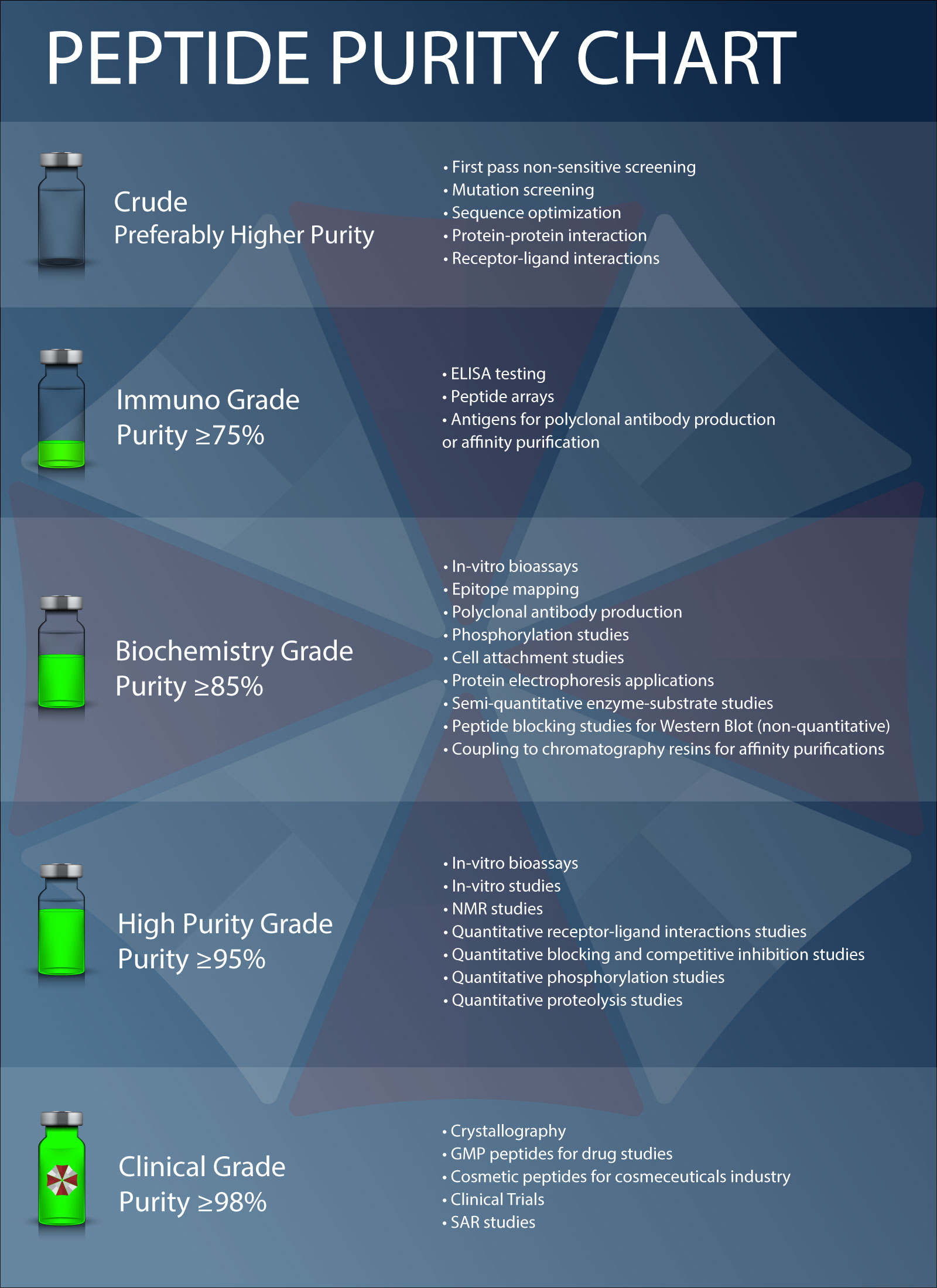
Peptide testing is the collection of analytical checks used to examine a peptide sample before it is used in a research operations. In useful COA testimonial, the term usually refers to purity screening, identity screening, and documentation review. Purity testing asks just how much of the detected sample is the major peptide versus associated contaminations. Identity testing asks whether the measured mass or sequence-related evidence matches the designated peptide. Paperwork testimonial asks whether the record is batch-specific, traceable, and described sufficient to be audited. Peptide screening is the logical procedure utilized to validate that a research peptide is both pure and properly determined.
A functional assay measuring downstream signaling-- or an architectural research study making use of NMR or X-ray crystallography-- demands the highest possible purity available. Crystallographers particularly often call for ≥ 98% purity since also small impurities can avoid crystal formation or present problem into the crystal lattice. As molecules exit the column, they go through a detector-- usually a UV detector set to 214 or 220 nm, wavelengths where the peptide bond takes in light highly. The detector records just how much UV light is absorbed with time, generating a graph called a chromatogram. This guide breaks down what pureness actually indicates in peptide chemistry, just how it's measured, what the impurities are, and just how to review the documents that verifies a peptide is what it claims to be. Discover our directory to see confirmed research compounds and discover more regarding our testing and quality assurance process. Also small contaminations can alter results, minimize reproducibility, or introduce undesirable variables right into a study. Researchers depend on accurate, confirmed compounds to guarantee their findings are both valid and regular.